
Release notes are often treated as a customer-facing afterthought a quick bulletin pushed to users after deployment. But in high-performing product teams, they're strategic assets that align sales, support, and marketing around a shared narrative of value delivery. When these internal teams lack visibility into product changes, the result is fractured messaging, reactive firefighting, and missed revenue opportunities.
For SaaS companies building on platforms like Lovable, where rapid iteration is the norm, automating release communication isn't just about keeping customers informed it's about creating a single source of truth that empowers every team to do their job better.
The Hidden Cost of Siloed Product Updates
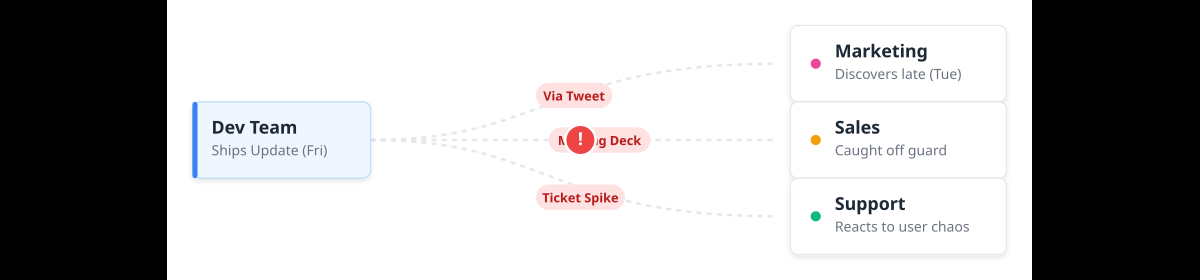
Consider a typical scenario: Your dev team ships a major workflow improvement on a Friday afternoon. Marketing discovers it the following Tuesday through a customer tweet. Sales learns about it when a prospect asks why it's not in the demo deck. Support finds out when tickets start pouring in from confused users.
This isn't just an operational hiccup it's leaving money on the table. When sales can't articulate new capabilities during negotiations, when support scrambles to explain undocumented changes, and when marketing misses the window to amplify feature launches, your product velocity becomes a liability instead of an asset.
Research from ProductLed Institute shows that companies with synchronized internal product communication see 34% higher feature adoption rates and 28% faster support resolution times. The gap isn't in the quality of updates it's in how they're distributed.
Sales: Turning Product Momentum into Revenue Stories
Sales teams need more than a list of features they need the context to position updates as solutions to prospect pain points. When release notes become part of the sales enablement toolkit, they transform from technical documentation into competitive ammunition.
Here's what effective sales-oriented release communication includes:
Business impact framing: Instead of "Added batch export functionality," try "Reduced month-end reporting time by 60% with one-click bulk exports."
Competitive positioning: Highlight capabilities that differentiate you from alternatives prospects are evaluating.
Deal acceleration cues: Flag features that address common objections or blockers in the sales cycle.
Demo refresh alerts: Notify account executives when their presentation materials need updating to reflect new UI or workflows.
With automated changelog tools, these sales-specific insights can be generated alongside technical documentation, ensuring reps always have current, persuasive narratives at their fingertips.
Support: From Reactive Troubleshooting to Proactive Guidance

Support teams bear the brunt of poor release communication. When they're blindsided by product changes, every customer inquiry becomes an investigation instead of a routine resolution. Worse, they lose the opportunity to guide users toward new features that solve their problems.
Effective release notes arm support with:
Behavioral change warnings: Clear documentation of UI modifications or deprecated workflows that might confuse existing users.
Troubleshooting primers: Known edge cases or migration steps for features that affect existing data or integrations.
Proactive talking points: Scripts for reaching out to affected user segments before they encounter issues.
Self-service resources: Links to updated help docs, videos, or FAQs that can be shared instantly in tickets.
When support teams have advance access to detailed release information, first-response times drop and customer satisfaction scores rise. They shift from damage control to value amplification using product updates as opportunities to deepen user engagement rather than just resolve confusion.
Marketing: Orchestrating Launch Momentum Across Channels
Marketing's job is to create narrative continuity across the customer journey from awareness content to in-product experiences. When release notes live in isolation, marketing campaigns feel disconnected from actual product evolution, eroding trust and relevance.
Strategic release communication enables marketing to:
Plan coordinated campaigns: Build email sequences, blog content, and social media around major feature drops with proper lead time.
Fuel content engines: Transform release notes into case studies, video tutorials, webinars, and thought leadership pieces that demonstrate expertise.
Segment messaging: Tailor announcements to different user personas based on which features matter most to each cohort.
Amplify product-led growth: Showcase high-impact updates that drive user engagement through targeted in-app and email campaigns.
The difference between a feature launch that gains traction and one that goes unnoticed often comes down to marketing's ability to create anticipation and context. That's impossible when they're discovering updates at the same time as customers.
Building a Cross-Functional Release Communication System
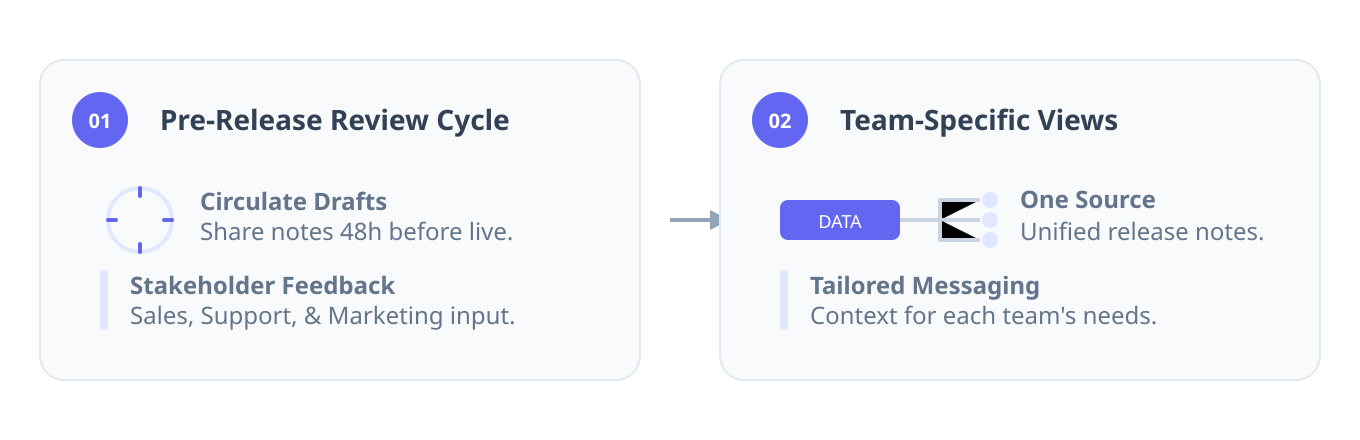
Creating alignment doesn't require elaborate processes it requires the right infrastructure. Here's a practical framework for turning release notes into organizational glue:
1. Establish a Pre-Release Review Cycle
Before features go live, circulate draft release notes to sales, support, and marketing stakeholders. Give them 48 hours to flag messaging concerns, ask clarifying questions, or prepare team-specific materials. This isn't about gatekeeping it's about giving internal teams the same courtesy you'd give beta users.
2. Create Team-Specific Views of the Same Data
Different teams need different lenses on the same updates. Sales wants ROI narratives. Support needs technical details. Marketing seeks storytelling hooks. Rather than maintaining separate documents, use tools that can automatically generate audience-specific versions from a single source.
3. Build Feedback Loops from Customer-Facing Teams
Sales, support, and marketing hear customer reactions first. Create channels for them to report adoption blockers, messaging confusion, or unexpected use cases back to product and engineering. This closes the loop and makes future release communication more effective.
4. Measure Internal Communication Impact
Track metrics like time-to-productivity for new features (how long until sales includes them in pitches), support ticket volume post-release, and marketing content velocity. These indicators reveal whether your internal communication strategy is actually working.
Automation as an Alignment Enabler
Manual release note processes inevitably prioritize external communication while internal teams get neglected. When you're rushing to publish customer-facing updates, there's rarely bandwidth left for sales briefings or support training materials.
This is where automation transforms organizational dynamics. Platforms like AutoLog pull changes directly from your development workflow, generating comprehensive release documentation without manual intervention. This creates capacity for the human work that matters crafting team-specific context, running enablement sessions, and gathering cross-functional input.
By eliminating the tedious work of changelog compilation, automation ensures every stakeholder gets timely, accurate information without requiring developers to become technical writers or product managers to play telephone between teams.
The Organizational Multiplier Effect
When release notes become a shared organizational resource rather than a customer-only artifact, something powerful happens: product velocity translates directly into business momentum. Sales cycles shorten because reps can speak confidently about the latest capabilities. Support costs decrease as teams prevent issues instead of reacting to them. Marketing generates more engaging content because they have a steady stream of concrete value stories to tell.
Most importantly, the entire organization develops a shared language around product value. Everyone from executives to front-line employees can articulate what's changing, why it matters, and how it serves customers better. This alignment is the foundation of scalable, sustainable growth especially for fast-moving SaaS companies where the product itself is the primary growth engine.
Getting Started: Your First Cross-Functional Release
You don't need to overhaul your entire process overnight. Start with your next significant feature release and try this experiment:
Draft release notes with three sections: customer-facing, sales enablement, and support considerations.
Share with representatives from each team 48 hours before launch and ask for specific feedback on clarity and completeness.
After launch, conduct a 15-minute debrief with sales, support, and marketing to capture what worked and what could improve.
Document the process and refine it for the next release.
This small shift in approach treating release notes as internal strategic documents, not just customer notifications will reveal immediate improvements in team coordination and external messaging consistency.
In March 2026, as product development cycles continue to compress and customer expectations for seamless experiences continue to rise, the companies that thrive will be those that move fast without breaking their internal communication. Release notes, when done right, are the connective tissue that makes organizational agility possible.
The question isn't whether your teams need better visibility into product changes it's whether you'll build the systems to provide it before your competitors do.
Published with LeafPad